
Who built it and who shipped it? Proving segregation of duties in ServiceNow
Every audit cycle I have worked on has come down to two questions.
The first: the person who built this change - did they also push it live?
The second: who holds elevated access to production, and should they still have it?
Neither question is complicated. Both can cost a compliance analyst the better part of a week. This two-part series looks at why, and then shows how xtype Compliance answers them from two dashboards. Part one focuses on segregation of duties: whether the person who built an update set also promoted it. Part two follows the access that can make an unapproved promotion possible.
01 · WHY THE QUESTION IS FAIR
Auditors want evidence instead of assurance
The question is not arbitrary. Segregation of duties in change management appears in nearly every framework a regulated company reports against. SOC 2 tests it. ISO 27001 names it. SOX ITGC testing walks it every year.
The standard for answering is not “tell me.” It is “show me.” An auditor does not want an assurance that developers do not deploy their own code. They want evidence that it did not happen over a defined period, across the full population rather than a convenient handful, with every item traceable to a source record.
A screenshot proves that one record looked a particular way on the day somebody captured it. It does not establish how that record was selected, what was left out, or whether the population was complete. The audit evidence gap
Most teams respond with screenshots and a written narrative. The narrative describes how a control is meant to work; it does not evidence that the control operated. Then there is the practical question that decides whether any of this happens on time: who can pull the evidence together?
Answering properly takes someone who knows which tables hold the data and has the rights to query them - usually a platform engineer or an administrator, not the compliance analyst who owns the deadline. That person is already committed to a sprint that has nothing to do with the audit.
02 · WHY THE USUAL ANSWER BREAKS
The data exists but it lives in different places
ServiceNow has the data. The problem is where it lives and who can reach it.
An update set - the XML record ServiceNow writes when a developer changes something - tells you who created it. The promotion tells you who moved it. Those are different objects. Answering “were those two the same person?” means joining them across however many instances you run and over whatever period the auditor asks about.
The question becomes a ticket. The ticket goes to the platform team. A CSV comes back two days later. The analyst opens it in Excel and starts reconciling by hand. Then the auditor asks a follow-up question, and the loop starts again. The platform team is on the other end of that loop, pulling exports against someone else's deadline.
That gap is what xtype Compliance is built to close. Its Segregation of Duties dashboard puts the first audit question in front of the analyst without a ticket or a custom report.
The developer who built a change should not promote it
xtype Compliance comparesthe developer recorded on each update set with the person recorded on thepromotion. A match is flagged as a possible violation, and every result linksback to the source record.
03 · THE DASHBOARD
Who built it and who shipped it
The Segregation of Duties dashboard opens on four donut charts: the proportion of promotions that may be violations, who performed them, which instance they happened on, and which applications they touched.
That layout is deliberate. Before reading a single row, you can see the shape of the review. If one name dominates the second chart, or one application dominates the fourth, you know where to start in a few seconds instead of after an afternoon of sorting.
Below the charts is the list, and every row is an update set. It is not a summary or a rollup. It is the actual artifact of the change.
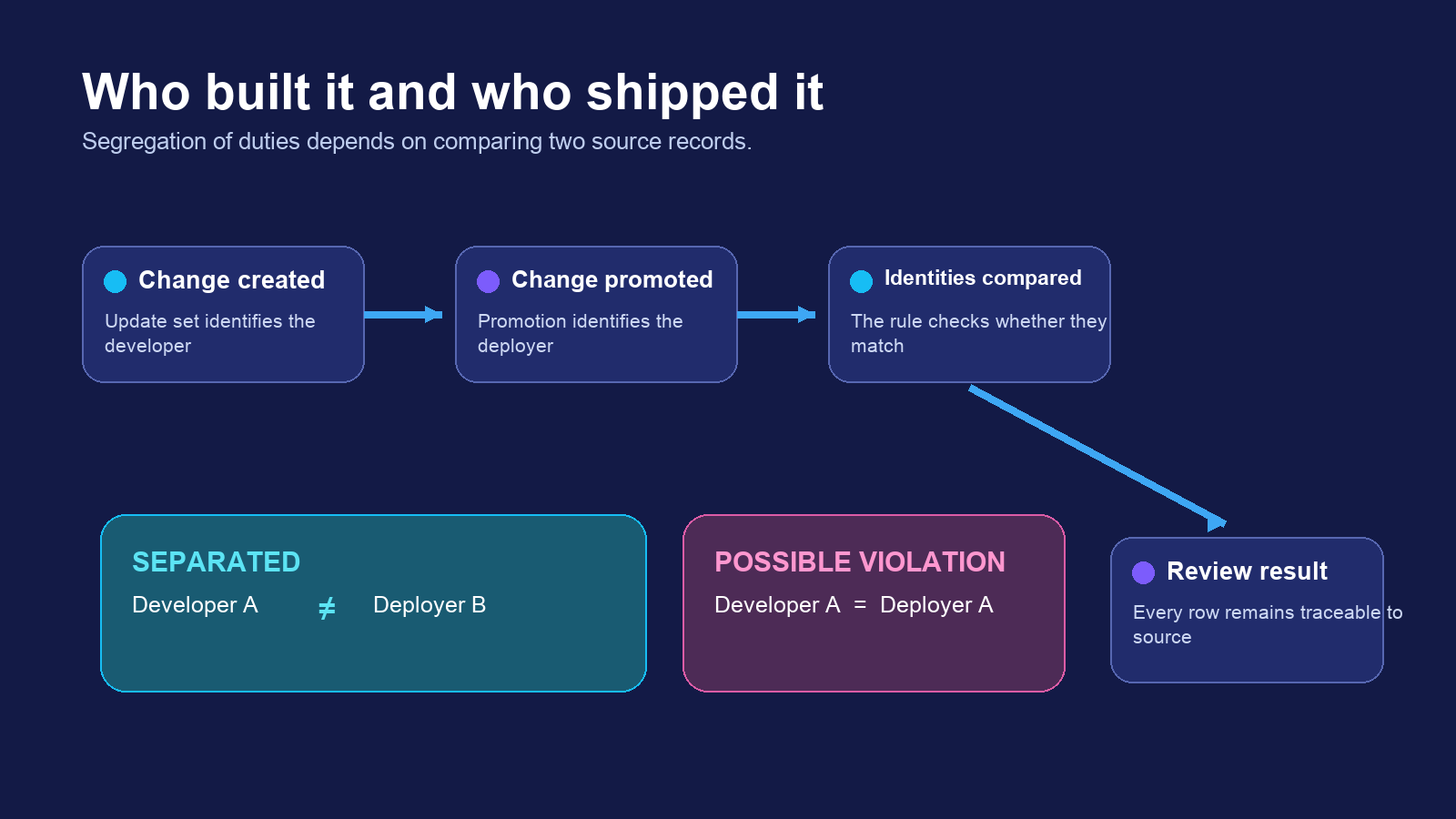
The dashboard applies one rule in the current release: the developer who built the update set should not be the person who promoted it. It is a fixed rule rather than a policy engine you configure, but it addresses the incompatible pairing auditors care about most: developer and production deployer.
The same evidence supports segregation-of-duties testing under SOC 2, ISO 27001 A.5.3, and SOX ITGC program change controls.
Two filters narrow the review. Date range sets the period in scope. Promotion source lets you review everything together or separate promotions run through ServiceNow from those automated through xtype.
Click any row, and you are inside the update set: timestamp, originating activity, who did what, and a path to the underlying ServiceNow record. There is no ticket, no CSV, and no two-day wait.
Date range
Set the exact period inscope for the audit or control review. The dashboard evaluates the fullpopulation of promotions in that window.
Promotion source
Review every promotion together or separate promotions run through ServiceNow from those automated through xtype.
Evidence the reviewer can work with
The value is not another dashboard to look at. It is a reviewable population. The analyst can filter the exact period, inspect possible violations, and trace every result to the record that produced it.
Next: who holds elevated access to production, how they received it, and whether they should still have it.
.svg)

