
How to Utilise ServiceNow Governance Best Practices

Robust governance on your ServiceNow platform is crucial to balance rapid innovation with stability. As your enterprise grows, conflicting demands, scattered ownership, and unchecked customisations can undermine your Return on Investment (ROI), increase risk, and complicate upgrades.
This guide explores best practices for ServiceNow governance designed to help platform owners, governance teams, and security leaders maintain control, reduce technical debt, and ensure your ServiceNow environment reliably supports evolving business needs.
What is ServiceNow Governance and Why Does it Matter?
ServiceNow governance is a structured decision-making framework that defines who makes decisions, what decisions need to be made, and how those choices align with business strategy, portfolio management, and technical standards.
It acts as a bridge between your organisation's strategic vision and operational reality, enabling consistent, transparent management of your ServiceNow platform.
Without ServiceNow platform governance, requests and changes can escalate chaotically, leading to platform sprawl, misaligned investments, and security vulnerabilities. A disciplined governance approach prevents these issues by:
- Aligning ServiceNow investments with broader enterprise goals.
- Streamlining decision-making to accelerate value delivery.
- Reducing business and technical risks through enforced best practices.
- Ensuring the platform scales efficiently as organisational needs evolve.
In essence, governance helps you get the right work done at the right time while protecting platform integrity.
Essential ServiceNow Governance Best Practices
You can strengthen control and scalability with your growing enterprise by following these foundational best practices:
1. Establish Clear Governance Roles and Committees
Form distinct governance boards focused on strategic, portfolio, and technical decisions. Common models include:
At the strategic level, an Executive Steering Board should oversee platform direction and ensure investment decisions align with wider business goals. A Demand Board can then review, assess, and prioritise incoming requests, shaping a realistic and value-driven project portfolio. Alongside this, a Technical Governance Board should safeguard platform stability, define development standards, and oversee upgrades and architectural decisions.
Assign executive sponsorship with authority and invite key stakeholders from IT, business units, security, and compliance teams to foster collaboration and ownership across the enterprise.
2. Define Structured Decision-Making Processes
Develop clear processes outlining:
- What decisions require governance attention.
- Who is empowered to make or escalate decisions.
- How decisions are reviewed, documented, and communicated.
Enable boards to prioritise high-value work and escalate complex or high-impact decisions appropriately, avoiding "decision bottlenecks" or "governance red tape".
3. Balance Out-of-the-Box (OOTB) Usage with Customisation Governance
Encourage teams to prioritise OOTB functionality first to ease upgrades and reduce technical debt. Custom development should support genuine business needs, not personal preferences.
Where customisation is required, it needs proper oversight. The Technical Governance Board should define approval pathways, development standards, and testing and release controls. Clear guardrails protect platform stability while still allowing room for innovation.
Using built-in tools such as Instance Scan and Health Scan helps you identify risks early and correct them before they escalate. By maintaining this balance, you preserve flexibility without compromising upgradeability or performance.
4. Enforce Role-Based Access Controls and Security Policies
Robust access governance mitigates insider threats and ensures compliance with data protection laws.
Permissions should be centrally managed, particularly for administrator and platform owner roles. Requiring appropriate training or certification before granting elevated access strengthens accountability. It ensures individuals understand both technical responsibilities and compliance implications.
5. Maintain a Healthy Configuration Management Database (CMDB)
Ensure your CMDB accurately reflects platform assets and relationships by assigning clear ownership and stewardship roles, enforcing data quality standards and regular health reviews, and integrating CMDB governance into your broader platform governance framework.
Setting measurable data standards and conducting regular health reviews keeps the CMDB aligned with operational changes. Governance should treat CMDB oversight as part of the wider platform framework, not as a standalone exercise.
A healthy CMDB underpins effective incident, change, and asset management processes. It becomes the foundation that enables informed decision-making across your ServiceNow environment.
6. Monitor and Continuously Improve Governance Effectiveness
Implement governance metrics such as:
- Number and types of decisions made by governance boards.
- Meeting attendance and participation rates.
- Escalation trends and technical debt inventories.
- Policy compliance rates and update frequency.
Regularly audit governance workflows, solicit feedback, and adapt policies to balance control with agility. The aim is to maintain control without stifling agility, creating a framework that supports innovation rather than slowing it down.
Common ServiceNow Governance Challenges
Many organisations face recurring governance challenges when managing ServiceNow. It is important to address these challenges with clarity and accountability to manage both the technology and the organisation’s governance.
These common challenges include:
- Lack of a clear governance framework leading to inconsistent decision-making and ownership confusion.
- Platform sprawl due to unchecked customisation and version drift that slows upgrades and increases technical debt.
- Insufficient stakeholder engagement causing slow responses and disjointed priorities across departments.
- Difficulty balancing operational demands and strategic initiatives, resulting in stretched resources and underfunded projects.
- Gaps in access controls and compliance oversight, exposing the platform to security risks and regulatory challenges.
Steps to Enact ServiceNow Governance
To put ServiceNow governance into practice effectively, you need structure and ownership from the outset. Here are some quick practical steps that you can use when deploying your framework to help with ServiceNow governance.
Prepare to Implement Governance
Appoint a program lead responsible for driving governance design and coordination. Understand existing technology governance policies to align your ServiceNow governance approach. Build a comprehensive project plan with timelines and milestones.
Build Your Governance Model
Recruit board members, define their charters, decision scopes, and set meeting cadences. Map information flows between governance entities to foster transparency and avoid silos.
Define Policies and Guidelines
Develop “golden rules”: concise guiding principles aligning with your organisational culture and risk tolerance. Supplement with technical governance policies addressing upgrade management, platform access, data security, development standards, and demand management.
Enable Change Management and Stakeholder Engagement
Integrate governance with your change advisory board to control modifications properly. Invest in communication plans to promote awareness and acceptance of governance policies.
Measure and Improve Governance
Set simple but meaningful KPIs, such as decision throughput and policy adherence, to track governance health. Schedule periodic governance audits, especially after upgrades or significant changes. Use learnings to refocus and recalibrate governance efforts.
Why Use XType for ServiceNow Governance Success
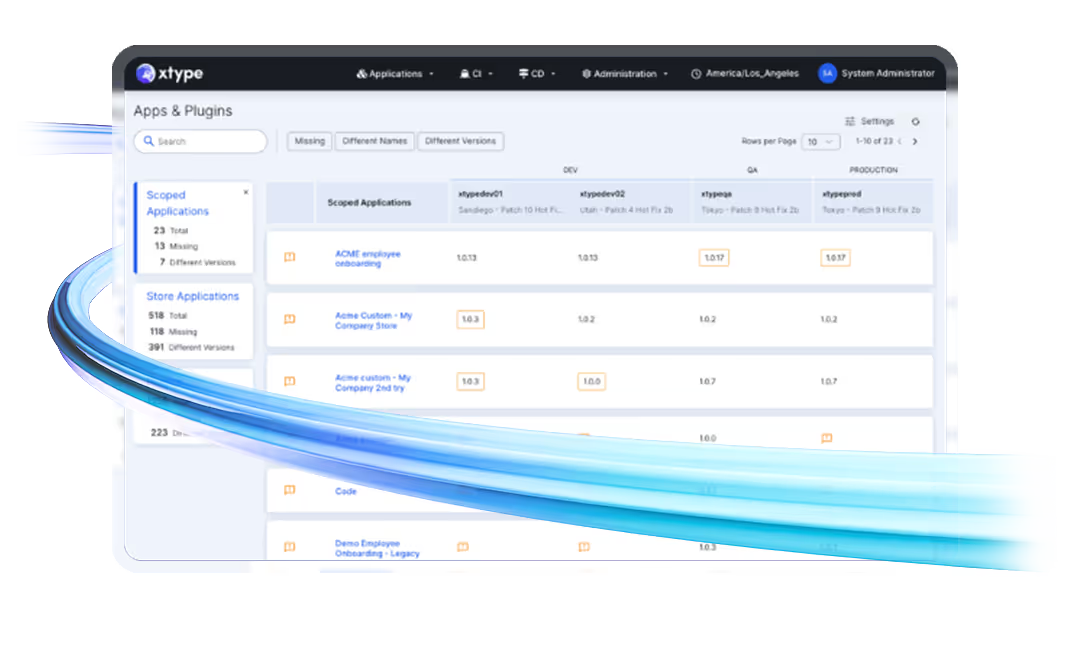
XType is a ServiceNow governance platform designed specifically for enterprises that require structured, automated governance to safeguard their ServiceNow environments. Unlike traditional bottlenecking governance approaches, XType ensures visibility and control while enabling innovation at speed and scale.
With XType, you can:
- Manage change safely with automated controls and risk reduction.
- Prevent misconfigurations before they impact critical business services.
- Eliminate technical debt through continuous governance insights.
- Improve upgrade readiness and maintain compliance across regions and business units.
Our platform empowers platform owners and governance teams to balance innovation with governance rigor confidently. Ready to explore how XType can transform your ServiceNow governance? Our experts are here to guide you toward a secure, scalable, and high-performing platform future.


Related Articles